

While paintings, prints, and photographs are the backbone of custom framing, three-dimensional objects carry a different kind of story. They hold presence, memory, and meaning in a way that demands thoughtful presentation.
3D object framing is a method for displaying dimensional objects inside a structured frame built with internal depth, spacing, and load support. It is used to safely present items that cannot be mounted in flat framing due to their volume or physical form.

What Is 3D Object Framing?
3D object framing is the broader system used to construct framed displays for objects with measurable depth. It relies on engineered internal spacing so items can be secured without distortion or pressure.
This approach is also known as deep frame construction or dimensional display framing. It is used when objects require both structural containment and visual presentation.
What Can Be Framed?
The possibilities for framing 3D objects are nearly endless. 3D framing is used when objects require depth-based containment instead of flat surface mounting.
Our custom framing team regularly works with:
- Sports memorabilia such as jerseys, balls, and equipment
- Military medals, insignia, and service items
- Musical instruments and components
- Collectibles and heirlooms
- Travel artifacts and personal keepsakes
- Sculptural or handmade objects
- Textile-based dimensional pieces
Each object is assessed individually to determine mounting method, spacing, and internal frame depth.
What Is a Shadow Box Frame?
A shadow box frame is a deep frame designed to hold three-dimensional objects within a protected interior cavity. The added depth allows items to be positioned away from the glazing while remaining stable and visually clear.
Shadow box framing is commonly used for memorabilia framing, collectible displays, and preservation-based object presentation where physical depth must be maintained without compression or contact.
Shadow box construction begins with determining internal depth and structural requirements before visual layout is finalized. Clearance is calculated to ensure the object remains suspended or stabilized without contact with the glazing.
Objects are mounted using conservation-safe stabilization methods such as hidden supports, archival adhesives, or reversible systems depending on material sensitivity. Each frame is custom-built because every object requires a unique internal structure.
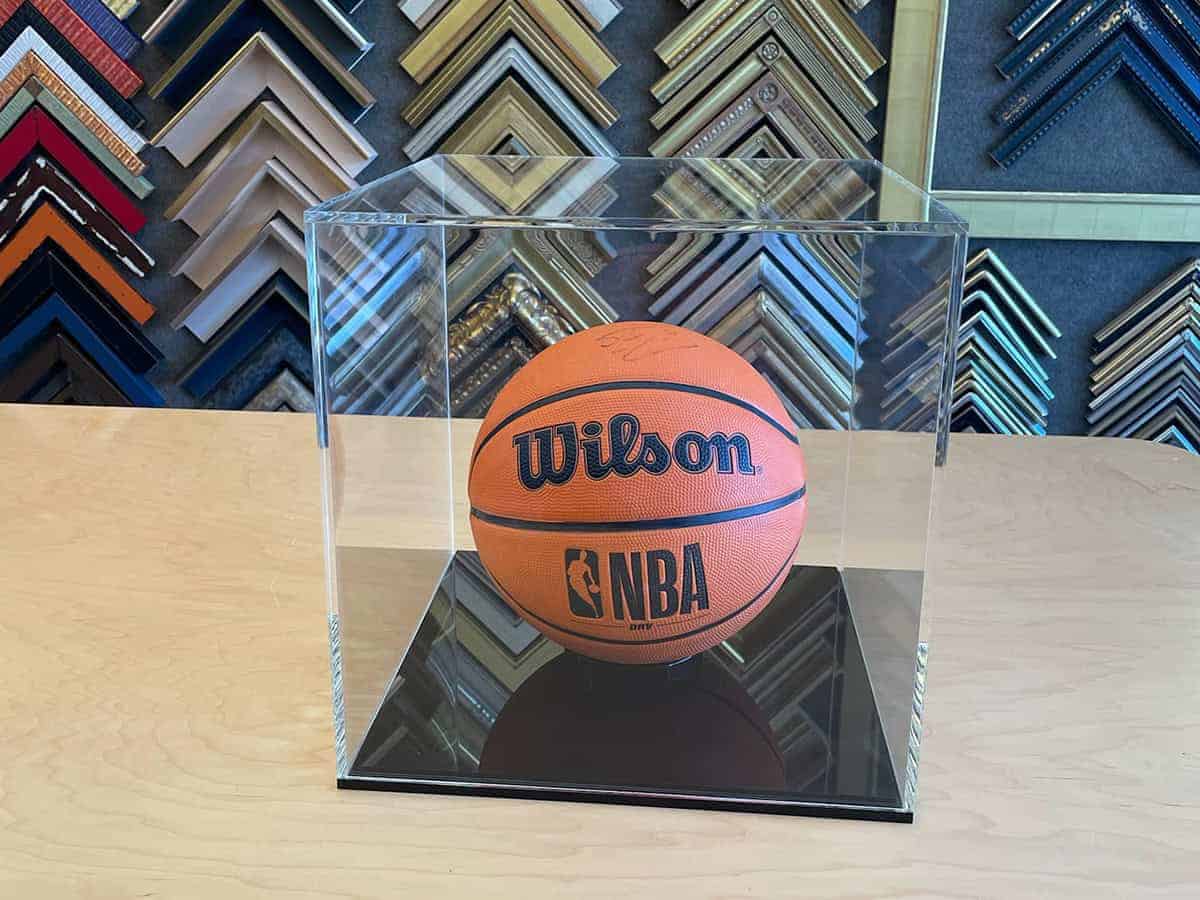
Another option for 3D framing is to create an acrylic ‘frame’ where there is a mounting system in the back or on the bottom and a frame made of acrylic on the face and all sides. This allows extra light and depth for your 3D pieces. A basketball in an acrylic box is a good example of this type of framing.
Preservation in Dimensional Framing
Preservation focuses on reducing exposure to light, humidity, dust, and handling stress that can degrade materials over time.
Archival methods such as acid-free backing and UV-protective glazing are used when appropriate to maintain long-term stability while supporting safe display conditions.
3D Object Framing vs Standard Framing
Standard framing is designed for flat artwork and surface-based presentation. 3D object framing is designed for volume, requiring depth, spacing, and internal structural support.
This difference allows dimensional objects to be displayed securely rather than stored or limited to passive viewing environments.
3D Object Framing in San Francisco
We see every 3D object at Capricorn Framing as an opportunity to create something unique. If you have an object that deserves more than storage or display on a shelf, we’d love to explore what’s possible. Stop by our Geary Blvd picture framing shop in San Francisco or call us for a consultation.
Learn how we frame medium to large 3D objects in this article.
Our Location
between Spruce and Parker
Hours
or call us for an appointment
Keep in touch!
Sign up for 20% off your first order!
Every so often, we send out announcement emails. We promise not to clutter your inbox!